



Executive Summary
Royalties are a core revenue driver for franchise brands, making accurate calculations critical to an effective royalty management process. But determining what each franchisee owes involves more than applying a percentage to a single sales figure.
Depending on the organization, royalty calculations may rely on information from POS systems, accounting platforms, P&L statements, or other sources. Brands may also collect marketing fees, technology fees, and other recurring charges that have their own calculation method and billing schedule.
When this information is gathered from multiple sources and calculated manually, the process becomes more difficult to manage and creates opportunities for error. As a franchise adds locations, finance teams have even more calculations to validate before invoices can be issued, further increasing the burden on teams and increasing the risk of errors in royalty calculations.
However, by building a consistent, repeatable process around the data validation and calculations that determine royalty payments, brands can reduce the risk of errors in their royalty management process.
Start With Reliable Source Data
Every royalty calculation depends on having trusted financial information to determine the amount due. That makes collecting and validating the source data an essential first step.
Depending on the brand, the information required to calculate royalties may come from a variety of sources. When teams have to manually gather that information from multiple places, the process is time-consuming and error-prone, before calculations even begin.
Franchises should establish a consistent process for:
- Identifying the source data required for royalty calculations
- Collecting the necessary information from each location
- Validating that the appropriate data has been received
- Auditing the information for errors before calculating amounts due
Creating a consistent process for collecting and validating source data gives finance teams a reliable foundation for royalty calculations while reducing manual effort.
Reduce Manual Work with Integrations
The way data moves into the royalty calculation process also matters. When financial information is spread across multiple systems, teams may need to manually gather and transfer the data required to calculate royalties. In addition to consuming staff time, manual processes create opportunities for errors and inconsistencies.
Download your copy
The Complete Guide to Franchise Royalty Management
Download Now
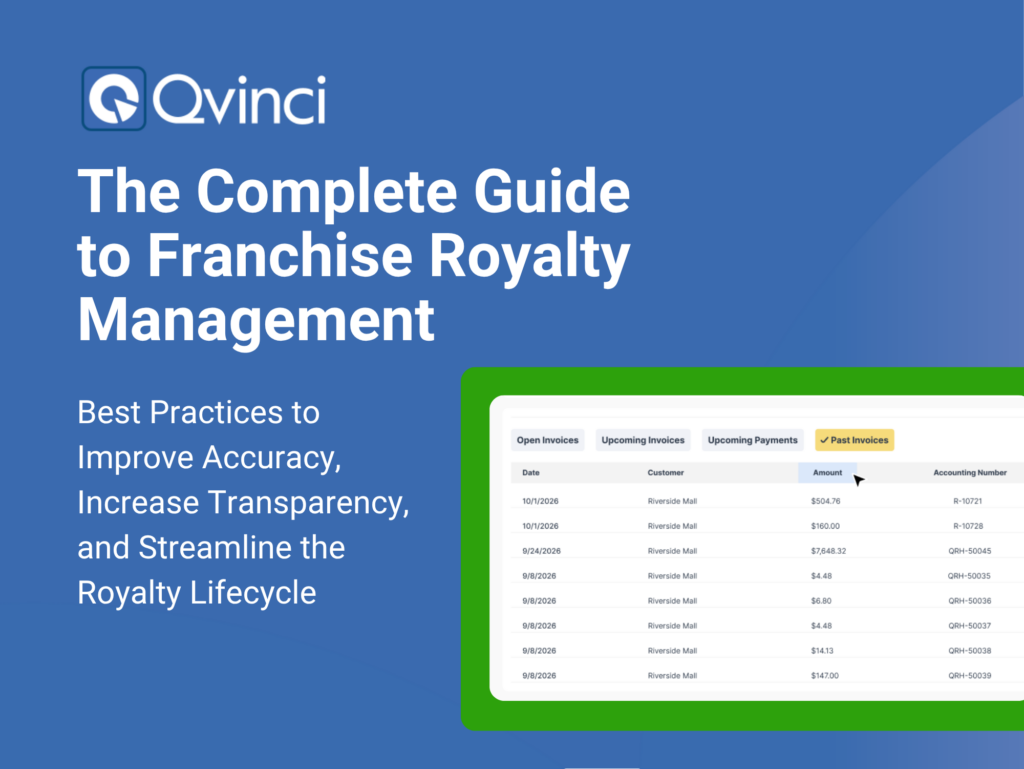
Integrations or structured data imports help reduce this manual effort by allowing sales quantities and other relevant data to flow into the calculation process. Recurring calculations can then be scheduled according to the franchise brand’s requirements.
When integrations or APIs are available, the goal should be to minimize unnecessary manual data movement between systems. Doing so saves administrative time while reducing the likelihood of errors that come with repeatedly moving and entering information by hand.
Automate Different Fees and Billing Schedules to Reduce Errors
Franchise brands may need to account for flat fees, marketing fees, technology fees, and other recurring charges in addition to royalties. These fees follow different calculation methods or billing schedules, increasing the likelihood for errors when finance teams manually manage each requirement.
Automation helps brands consistently apply established calculation rules and billing schedules. Once fee amounts are determined, invoices are automatically generated according to the brand’s preferred cadence.
Different recurring fees can also be combined on a single invoice or billed separately depending on accounting practices and franchise agreements. By automating this process, brands significantly reduce repetitive manual work and the probability of errors that come with managing multiple fees and schedules by hand.
Build a Repeatable, Automated Royalty Calculation Process to Reduce Errors
The objective is to create a repeatable process that produces accurate royalty calculations without requiring finance teams to rebuild the process every billing cycle. This is only possible when teams aren’t relying on manually collecting data or calculating royalty fees. By automating this process and leveraging integrations, brands can ensure their royalty calculations are accurate every time.
For a closer look at royalty lifecycle best practices, download The Complete Guide to Franchise Royalty Management.
FAQ
1. How are franchise royalties calculated?
Royalty calculations are based on the financial information and fee structures established by the franchise brand. Depending on the system, the required data may come from POS systems, accounting platforms, P&L statements, or other sources. Brands may also need to calculate marketing fees, technology fees, flat fees, and other recurring charges according to different calculation methods and billing schedules.
2. What causes errors in franchise royalty calculations?
Errors become more likely when financial information is gathered from multiple sources and calculations depend heavily on manual processes. Fragmented systems, spreadsheets, manual data movement, and multiple fee structures increase administrative effort and create a higher likelihood of errors and inconsistencies.
3. How can franchise brands improve the accuracy of royalty calculations?
Franchise brands can establish consistent processes for collecting and validating source data, applying appropriate royalty rates and recurring fees, and accommodating different calculation and billing schedules. Integrations or structured data imports can further reduce manual work by allowing relevant data to flow into the calculation process, while recurring calculations can be scheduled according to the brand’s requirements.
4. Can franchise royalty calculations be automated?
Yes. Automation can reduce the manual work involved in royalty calculations and improve accuracy. Integrations or structured data imports allow sales quantities and other relevant information to flow into the calculation process, while recurring calculations can be scheduled according to the franchise brand’s requirements.
5. Why do franchise royalty calculations become more difficult as a brand grows?
As a franchise brand adds locations, the volume and complexity of royalty management increases. More locations means more data to collect and validate, more calculations to perform, and more opportunities for errors, particularly when teams rely on manual processes, spreadsheets, and disconnected systems.