

Executive Summary
Effective royalty management starts with an efficient process. However, the activities involved in royalty management — collecting sales data, calculating royalties, generating invoices, collecting payments, following up on overdue balances, and reconciling transactions — are challenging to streamline. When these activities happen across disconnected systems or rely on manual effort, inefficiencies compound and the likelihood of errors increases.
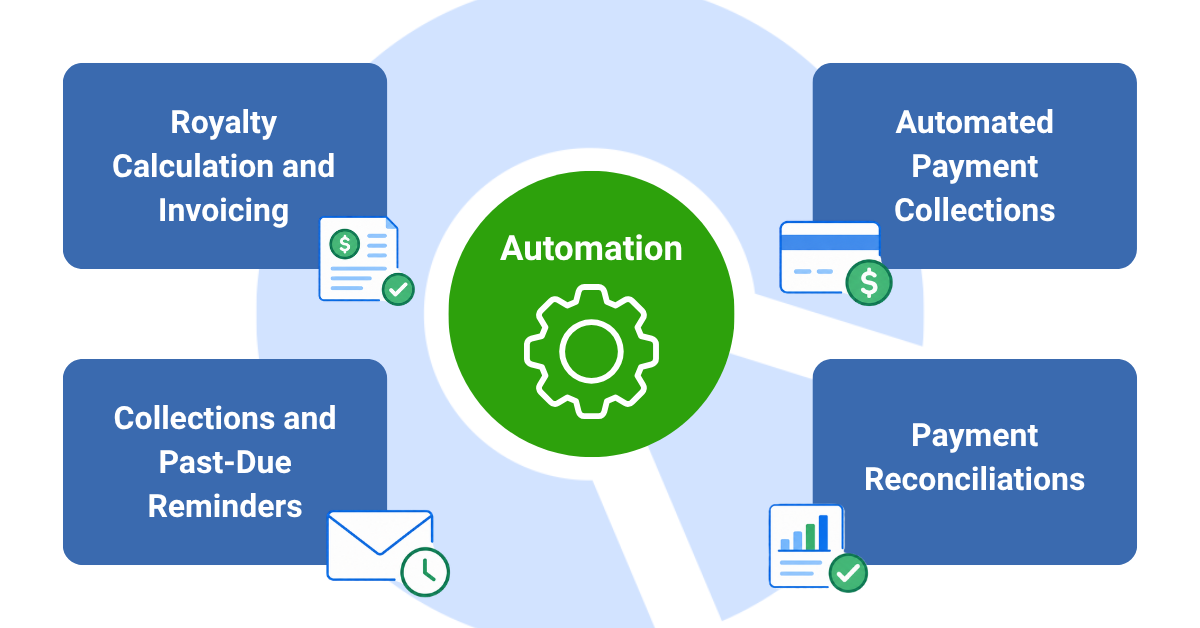
By automating stages of the royalty lifecycle, franchise brands can replace repetitive, manual tasks with integrated workflows that save time and reduce errors. Here’s where automation belongs in an efficient, scalable royalty management process.
1. Royalty Calculation and Invoicing Processes
The first steps to automate in the royalty management process are fee calculation and invoicing workflows. Royalty fees are typically calculated off sales data, while marketing or technology fees are often flat fees collected every month. Manually collecting sales data, calculating the various fees, and generating invoices can slow down the royalty calculation process and leave brands open to errors.
Automating this workflow reduces manual data collection and fee calculation, while ensuring invoices are generated according to established billing schedules. Brands can also automate recurring charges, including marketing and technology fees, and combine fees on a single invoice or bill them separately as needed to streamline this process across locations.
Download your copy
The Complete Guide to Franchise Royalty Management
Download Now
2. Payment Collection Workflows
Once invoices are generated, franchisees need a straightforward way to pay them. Offering franchisees flexible autopay options that allow them to pay by ACH or debit/credit card gives franchisees a way to simplify the payment process while helping brands collect payments more efficiently and consistently.
3. Collections and Past-Due Reminders
Even with a streamlined payment process, late payments will happen. Without automation, finance teams must identify past-due balances, send reminders, track grace periods, and apply applicable late fees. Automated collection workflows can handle these tasks by sending reminders on a defined schedule and applying late fees to invoices when grace periods expire, freeing your team up from manually following up about overdue invoices while creating a consistent approach to collections across locations.
4. Payment Reconciliation Processes
Collecting payments is only part of the process. Finance teams must also ensure payment records, including any applicable late or failed payment fees, are accurately reflected in their accounting systems. When payments fail, automated workflows can reinstate the outstanding amount, apply applicable fees, and notify franchisees of updated balances. Integrations with accounting platforms can also synch payment activity, reducing manual entry and helping maintain consistent records across systems.
Connect Every Stage with Royalty Automation
Automating individual tasks can save time, but the greatest impact comes from automating and connecting the entire royalty lifecycle—from sales data collection and royalty calculation to invoicing, payment collection, and reconciliation.
Qvinci® RoyaltyHub automates these essential workflows, helping franchise brands reduce administrative overhead, establish consistent processes, and improve transparency for both franchisors and franchisees.
Ready to streamline your royalty process? Download The Complete Guide to Franchise Royalty Management to learn more about how to streamline your royalty management processes.
FAQ
1. Why should franchise brands automate royalty management?
Automating royalty management helps franchise brands reduce manual administrative work, minimize calculation and processing errors, and collect payments more consistently. It also creates more standardized processes, improves visibility into outstanding balances, and frees staff to focus on financial oversight and franchisee performance.
2. Which parts of the royalty management process can be automated?
Franchise brands can automate four key stages: royalty calculation and invoicing, payment collection, past-due reminders and collections, and payment reconciliation. Automation can include collecting sales data, calculating royalties and recurring fees, generating invoices, enabling autopay, sending overdue reminders, handling failed payments, and synchronizing financial data with accounting platforms.
3. Can royalty management software integrate with accounting platforms?
Many royalty management solutions integrate with accounting platforms to consolidate financial data and reduce manual data entry. These integrations can help brands maintain consistent records between royalty transactions and their accounting systems, making payment reconciliation and financial oversight more efficient. Available integrations and synchronization capabilities vary by solution.
4. What should franchise brands look for in royalty management software?
Franchise brands should look for a solution that supports the full royalty lifecycle, from sales data collection and royalty calculations to invoicing, payment collection, past-due management, and reconciliation. Flexible payment options, automated reminders, accounting integrations, and visibility into franchisee balances can help brands build a more efficient process that scales as the franchise grows.